Brett Jackson - The Foggy Author - Writing through the haze of brain fog
Menu
  • New Here? Welcome
  • Books
  • Hog Blog
  • Video wall
  • Book Signings
  • About
  • Author Tools
  • Contact Me
  • Novel Updates
  • Libros Studio
  • Indie Novel Kit
Menu

Tag: writing

detox text on round blue plate

Day 23 – Distraction-free writing

Posted on 24 March 2021 by Brett Jackson

In this weeks post, read about…
How the experiment is going so far, Wellness walks, and boundaries for mental wellness, and what the detox has meant for me.

How is the experiment going so far?
At the beginning of this month, I let the charge run out on my iPhone, and iPad, and I bought a flip phone.
The experience has changed me immensely. I no longer panic about missing the next news bulletin, or have the need to respond to people on social media straight away.
My wife and I have carried on with our daily “wellness walks” (walk outside somewhere new for 1 hour minimum, only answer phones to family, and don’t talk about work) and after a few days where we didn’t know where to go, we have discovered some new parks, walked along the beach, and even went for a drive to walk around a lake (within government guidelines of course).

Wellness walks and boundaries for mental wellness.
As a part of the anxiety crackdown, we have noticed that working at home through lockdown, has been very easy to blur the lines between work and Homelife. It’s too easy to drag the laptop into the living room so you feel more comfortable on a zoom meeting, or eating whilst at the computer, because we have work to catch up on, even working overtime seems to have become a social norm these days.
Acknowledging this, my wife and I decided to do something about it, and have put up boundaries, declaring that each room must have a purpose… dining room for eating, office only for work, living room for relaxing, etc. Putting these rules into effect has made a huge impact on our lives, and we no longer feel drained of energy, or fed up with working at home, while the wellness walks provide us with the chance to get into a different environment, and away from the home working scenario.

What has the detox meant for me?
Detoxing from Social Media has really helped me to put my life under the microscope, and both my wife and I now work smarter, not harder. Considering the fact that I bought my iPad and pencil for writing, I have barely used it for that purpose, and it has become my source of entertainment in the past, watching Netflix whilst washing up for example. Unfortunately… I tend to binge watch, and so, this experiment has not only helped me to balance my digital social life (on my computer only now) but also my working life, because I can concentrate more, and not feel the need to watch more YouTube, or Netflix, which also chewed up a lot of my time now. I have even (on occasion) considered getting rid of my iPad, and sticking with the flip phone after the experiment.

All in all, this experiment has been massively influential in the way I used to run my life when Social Media controlled me, and the changes I feel, have definitely made a huge difference, not only to my social life, and working life, but to my wife, family and friends too.

If you wish to detox your social media life, and get back in control, instead of being chained to your mobile phone all the time, why not do a search on your favourite search engine? Help is only a click away 🙂

gold ipad beside stylus

What’s happening this week?

Posted on 9 February 2021 by Brett Jackson

Title Reveal for the Time Travel Novel
Coming Soon, I will be revealing the title for the Time Travel Novel I am writing, and hope to have a cover reveal too. The book is currently still being written, and at roughly two thousand words a day, I hope to be finished around the start of April 2021.

Camino Diary
In 2019, my wife and I walked 540 miles (800km) from St.Jean Pied-de-Port across the Pyrenees mountains through the Navarra and Rioja regions for 6 weeks to Santiago in Spain. We recorded our journey, and I aim to be writing a book about it in the Summer of 2021. For more details, please check out the bookstore.

Levelling Up
So, the Next Level Authors had their zoom meeting last night, and it was brilliant. I learnt so much about marketing, and realised where I had been going wrong. I now hope to be able to use this information to be able to make my business flow much better.

The writing habit
I have now completed the rearranging of my writing area, and am now 90 degrees to the left of where I was sat. This gives me good lighting from the left and right of the room, and also allows me to have a larger writing space.
The best bit about this is, I feel a lot more comfortable in this new position, and have even hung a picture up on the wall, which I couldn’t do before.
My writing sprints have now become a regular thing, and I am recording them in a log, to show myself how far I have come.
I now use the app Be Focused Pro and it gives me a chance to have sprints at intervals. The first sprint is 25 minutes, then it forces a five minute break, another 25 minutes, and a five minute break, and so on. After 4 sprints I get a 25 minute break. Typically I am able to now get on average around 1000 words per hour, which I am very happy with.

Pinterest
I have resurrected an old Pinterest account, given it a good scrub down, and a coat of paint, and now I am ready to start uploading various pictures to it.
If you want to check it out, the link is http://www.pinterest.com/brettishbooks

Thanks for reading.
Until next time, have fun.

Brett

notebook

A no-fluff step by step guide to writing your novel from start to finish.

Posted on 22 November 2020 by Brett Jackson

Warning: This is a long post… I make no apologies for this, because, if you want to be a writer, you’ve got to read, there is no way out of this. 🙂
I’m currently reading The Anachronist (in case you were curious).

So, without further ado, I present to you “A no-fluff step by step guide to writing a book from start to finish, written by Brett Jackson”.

To start, you will need:
– An idea.
– Pen/pencil and paper or Computer / Laptop / smartphone / typewriter / digital tablet, etc.
– A comfortable workspace with no distractions.
– Something to drink (it’s important to keep hydrated).

1 Premise
Write a one liner explaining what your idea is about (example: A man accidentally travels to 1955 in a Car) so you don’t feel like an idiot when people ask you what your book is about. This one-liner is called your Premise.

2 Blurb
Now, turn your one-liner into a paragraph packing more detail in.
(Example, After the doc bangs his head on the toilet, he invents the flux capacitor which makes time travel possible. He then builds the time machine out of a DeLorean, Marti accidentally travels to 1955 and his mum falls in love with him. His mission is to get his mum to kiss his dad, so he can be born and get back to 1985 before Biff tries to stop them kissing.)

3 Outlining
Next, you need to write your outline like a set of bullet points
Example: 
. Marti goes to docs house
. He gets a call from the doc
. Marti realises he is late for school
. etc, etc.
This list is good for writing a synopsis and will save you lots of work later, If you write it now, by writing a couple of pages based on this list.
Do this from the start of your plot through the middle to the finish, do not stop halfway through and skip the rest of this step, you will really regret it later.
As you write this bullet list, you begin to think about your Main Characters (MC / Protagonist / Hero), your Very Evil Bad Guy/Girl (VEBG / Antagonist/villain), and all your other characters.
Write descriptions of your characters, so you can refer to them whilst writing. What they look like, where they come from, age, race, species, height, what do they like? Phobias? Favourite foods, annoying habits, etc.

Pro tip: Make your villain bad, because good books usually always have bad villains.

4 The first Draft
Now write a paragraph for each bullet point (crossing off each bullet point as you complete it). This bullet point system is great for remembering what you are writing about and prevents writer’s block because you already know what to write about.

Take regular breaks every 15 minutes for approx 5 minutes (something I am rubbish at doing) and get yourself a drink, comfort break, go for a walk, some food, etc… this gives your brain a chance to rest. 

Once you have finished this, you have completed your first draft. 

5 Second draft
Now go back and expand each paragraph to 1 to 2 pages, including more detail, adding the six senses. Smell, taste, touch, sight, sounds, and emotions. Record how your characters feel, add what they can see, if they eat something they don’t like, how they react to that, etc
This is called the second draft.

6 Reading, Writing, and Editing (grammar checking, proofreading, and checking your stories flow) Editing and proofreading are essential, you can try and do this yourself.
Examples of good writing software include:

Software
. Zoho Writer (free) is an online resource that is great for this with built-in spellchecker and grammar checker.
. Google docs (free) also has a built-in spell checker
. Scrivener (paid, but worth it) is great for its corkboard system where you can move pages around and make your story more readable.
. Microsoft Word (paid) is also available online, so is good with Grammarly in your browser.
. Grammarly (free and paid, now writing software, but a browser addon) checks your spelling and grammar as you write saving you lots of time editing at this part of the process.

Get on social media and get yourself known. 
Read, lots and learn the craft. 
Great books include:
Libbie Hawker: take your pants off
Stephen King: On writing
Randy Imgermanson: The snowflake method
Google for more, there are thousands. 

7 Book Cover
They say “Never judge a book by its cover”.
In today’s world, your book cover may end up as small as a thumbnail sized picture on your smartphone, and with lots to choose from as you scroll through pages and pages of thumbnails on your favourite ebook shop, you may have realised you do look at the picture first, the title, author, and then read the blurb. Book covers are important.
There are several places to create book covers, if you want to make your own. www.canva.com is one such place, and when used with places such as www.unsplash.com www.pixabay.com and www.pexels.com you can actually come up with some very good designs.
However, if you’re not a budding artiste, you may find that a search for a book cover artist on fiverr.com is a better idea. After listening to the Six Figure Author podcast, I have found that the more you spend on a book cover, the more books you are likely to sell. However, this can become costly, and is probably better suited when you start getting more money in from selling your books. It’s a bit of a viscious circle to be honest, but if you write good books, you are likely to sell more, and get those good book covers faster.

8 Publishing your book.
IMPORTANT: Publishers will pay you, do NOT pay to get published, you may get ripped off.

For a list of UK publishers check out www.writersandartists.co.uk 

If you plan to digitally publish try:
– Kindle Desktop Publishing (Amazon)
– Draft 2 Digital
– Ingram Spark
– Google for more.

Remember:
. Writers write
. Good writers get published
. The best writers get famous

Have fun, nobody has said it’s going to be easy, and by giving you this list, you don’t have to stick to it, but by having fun, you will find that writing doesn’t feel like work, and you will end up joining a great group of people the whole world over.

I hope this helps. 

Too long didn’t read? 

If you’re expecting a shortened version of this, you’re out of luck. A major part of writing is reading, so if you really want to be a writer, go to the top of this post and read through. You will not be disappointed, and you may just find that a lot of the points covered here (for free) are the main points you will find in books that you end up paying for.

PS buy a bookshelf, you will need it 🙂

That’s all for now, now go and write 🙂
Map of Glenbrook Abbey

How’s my book coming along?

Posted on 10 October 2020 by Brett Jackson

I’m glad you asked.

So far, I have successfully reached chapter 7, with a lot of background done, this writing should increase with speed, as most of the next section is already written, I just want to tweak it, so that it fits with my new outline.

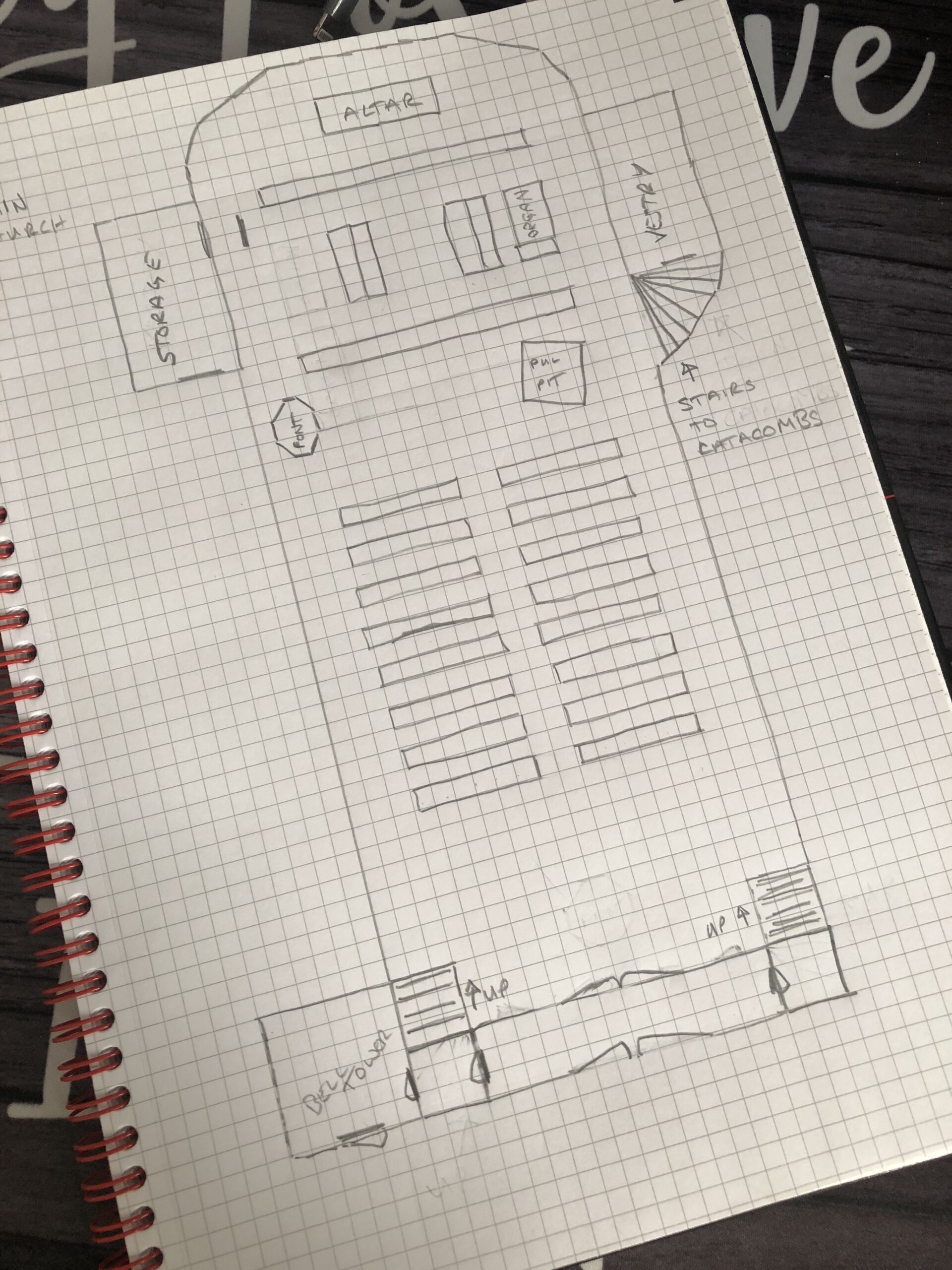
Also, I have been busy doing some more world building, in particular, I want to introduce you to Glenbrook Abbey.

Map of Glenbrook Abbey

This building is key to the book I am writing, and as such needed some thorough working out. I drew the bas map, showing the picture, then a few pieces of tracing paper later, managed to teak it, so that it changes as the story goes along.

Drawing maps, blueprints etc, is a great way to be able to visualise things, and really iron out any creases. This also means you have the opportunity to really describe things without confusing the reader, whilst also leaving a lot up to their imagination. It also means that you can deal with continuity, and prevent confusing yourself whilst writing it.

For the moment, I would prefer not to give the title away, because I feel that this would give too much away to do with the plot, so I have decided to name it simply – Project Glenbrook.

Sidenote: For anyone interested in the notebook I am using, it’s an A4 Oxford Black’n’Red, and as a hardback spiral bound notebook, it’s one of my favourites.

Thanks for reading, and supporting me, I really appreciate it, and I feel that you really won’t be disappointed when the book is released, until then, I am just going to keep on writing.

How to stop constantly re-editing your work, and focus on writing.

Posted on 3 June 2020 by Brett Jackson

One of the biggest issues I see, is when people try to write a book, and they spot a mistake, so they fix it. And then… they spot another mistake, and they fix that too, then… a third problem, and something else to tweak in chapter 4, and back to chapter 1, and so on and so on. Before you know it, there is a whole new story being written, loads of stress, mistakes and plot holes everywhere, and the cat is clawing at you trying to go out… well, probably not that last part.

So… what can you do about it? I’ve experienced this exact same issue, and this is how Indeqlt with it… by carrying on with writing and focusing on what’s next, instead of fixating what you have already done.

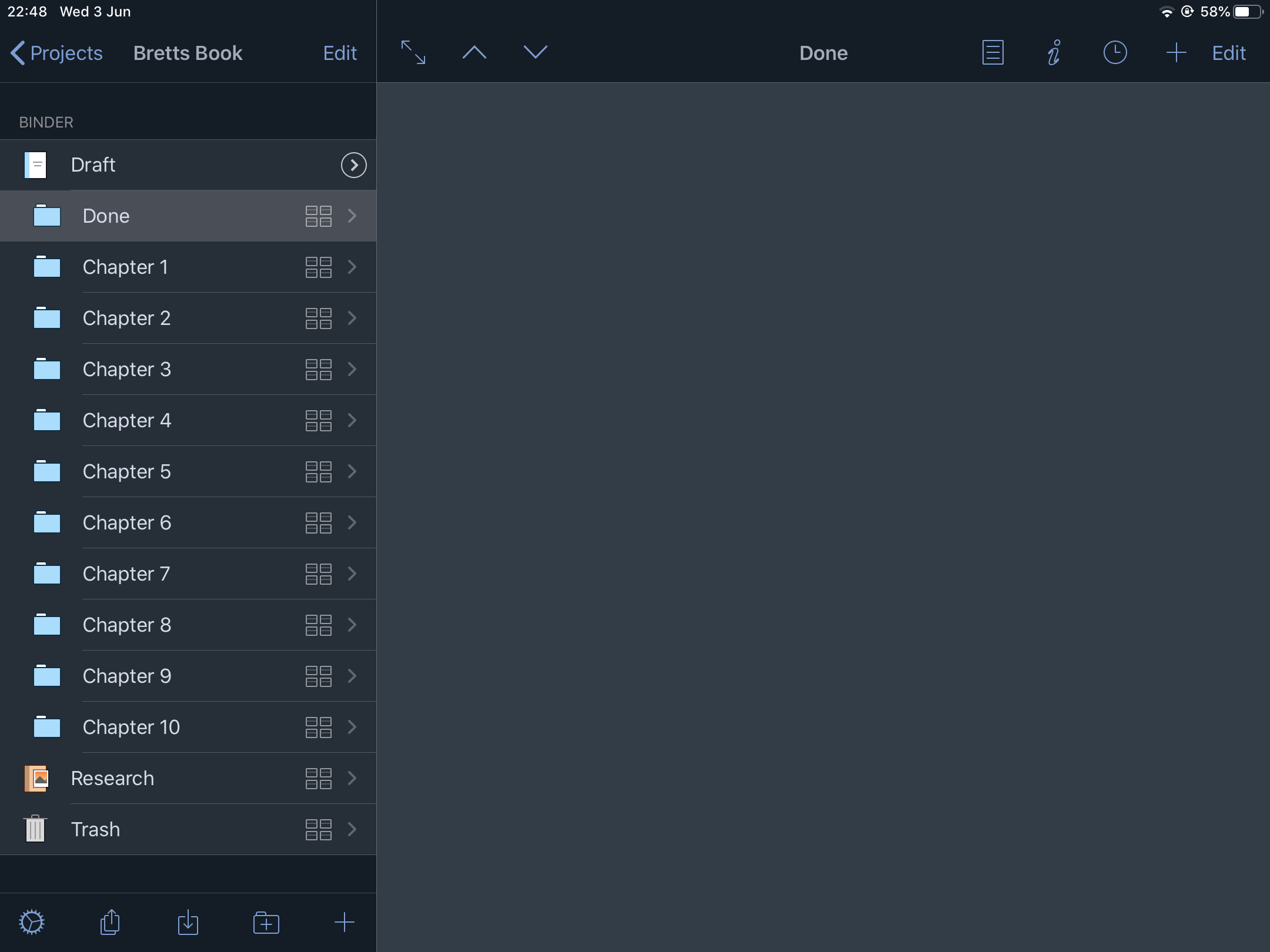
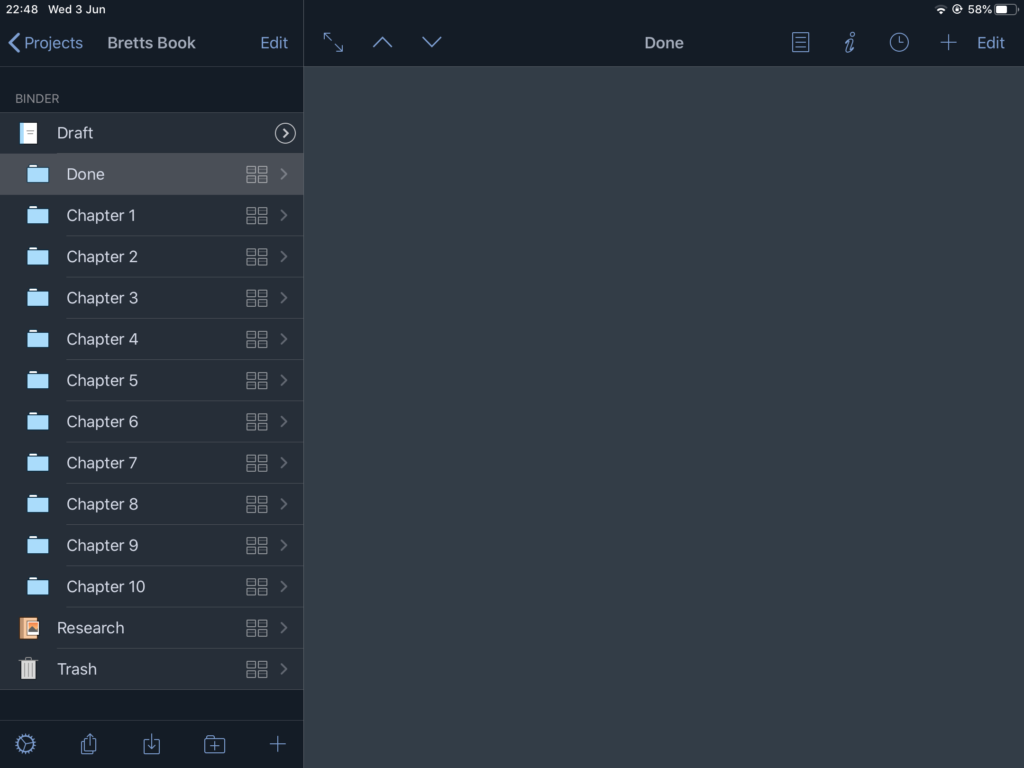
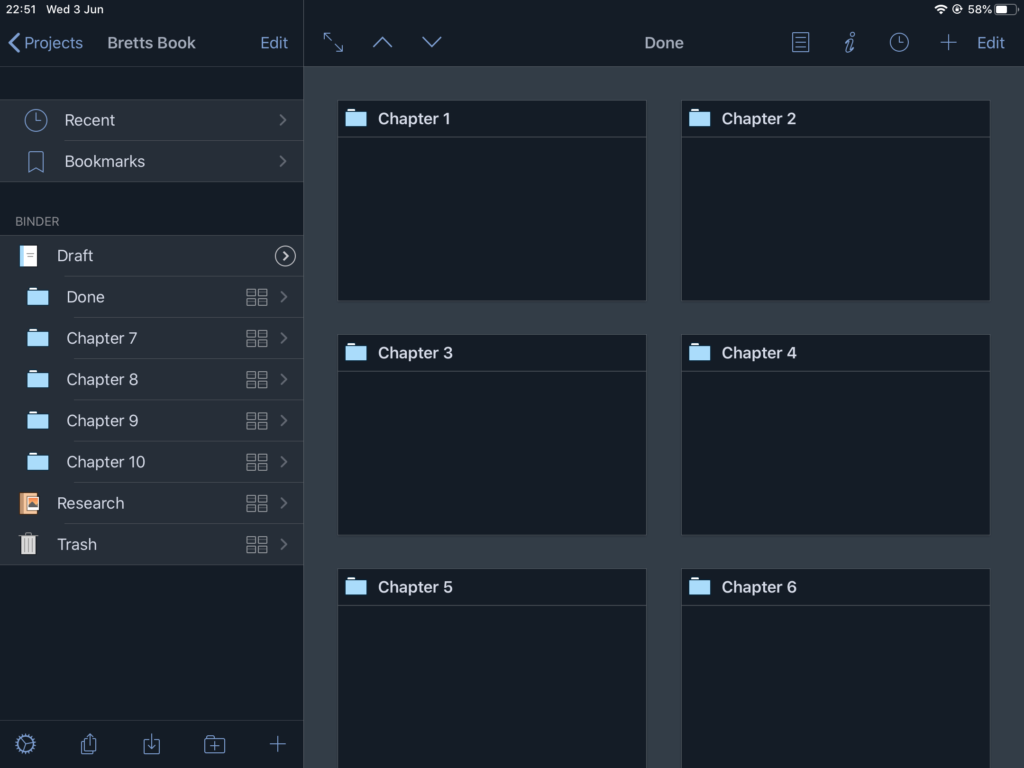
Cut your book into chapters… make a folder marked Done. 

What you have, should look like this…

Figure 1: Make a “Done” folder, ready for when you have finished each chapter.

Now, every time you finish a chapter, drop it into the folder marked done. It should then look like this.

Figure 2: Contents of “Done” folder – all completed, ready to be edited, once the book is completed.

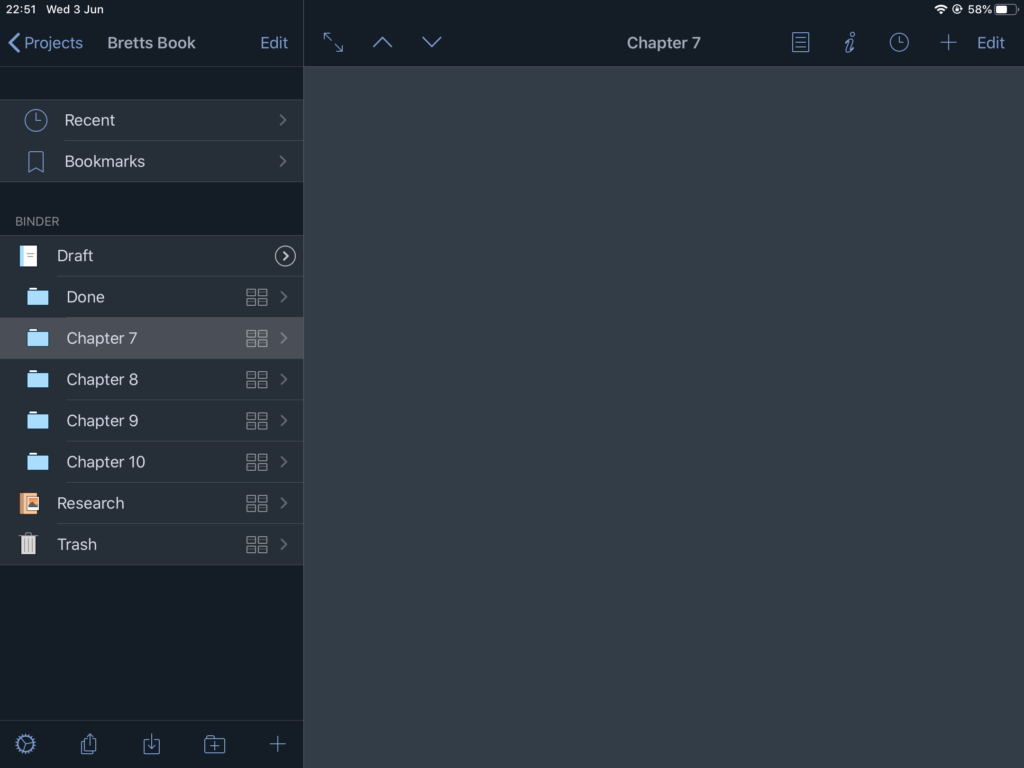
This creates more focus and less stress from being distracted.

Figure 3: You can now focus on on writing chapter 7, knowing that Chapters 1 to 6 are tucked away

Hope this helps.

WordPress conversion

Posted on 10 February 2020 by Brett Jackson

Hi everyone, just wanted to pop a message online and let you know that the blog is now converted to wordpress for ease of use, more expansion, and more functionality.

Thanks for sticking with me through this process, and I hope to add more content really soon, until then… Happy writing 🙂

Fed up with writing?

Posted on 21 December 2019 by Brett Jackson
Have you become fed up with writing?
Here are a few things you can do to get the excitement back 🙂
  1. Go for a run, take the dog for a walk, or buy a dog and take it for a walk… seriously. Running helps the blood pump more oxygen around your body and wakes up your brain.
  2. Do something mundane. There’s nothing quite like washing up to get your mind wondering about other things. Try it, you might be surprised.
  3. Try reading a Book from a different genre. Different genres generally mean different authors, different ways of thinking, and different plotlines.
  4. Have a rest – our brains, like our bodies, need rest. You may enjoy writing, but your brain is probably just tired. Even the best authors rest, to relax their brains and get back that creativity. But don’t rest for too long, otherwise procrastination starts to creep in.
  5. Have you tried changing medias? If you type, grab a pencil and pen, if you scribble notes down, try a laptop instead. Writing isn’t just words, its creating. We create using pictures, mindmaps, and more. Why not try drawing  a map, it will help you to describe what you are trying to explain. 
If you have any useful tips, please, feel free to add some 🙂

Writers block?

Posted on 17 December 2019 by Brett Jackson
Have you ever been driving down the road and gone the wrong way to a dead end? Every time that happens, you reverse the car and try a different route. 
Writers block is similar, you can sometimes write yourself into a dead end… soooo, go back a chapter and see write from there, see where it takes you 🙂
Have fun, happy writing.

How long should a chapter be?

Posted on 16 December 2019 by Brett Jackson

New to writing? Wondering how long a chapter should be?

There are no rules and no magic number.
Let me explain.
————-
Think back today… what did you do?
  • Chapter 1
You woke up, you got up, you got dressed, had breakfast, checked your email / social media, and then went to work.
  • Chapter 2
You arrived at work, checked your work email, got some work done, and had a coffee. Your colleague invited you to lunch
  • Chapter 3
You and your colleague met up for lunch, you both ate the same thing (how cool is that), you complained about work, then, without warning… a bomb goes off
  • Chapter 4
Dazed and confused you make your way to the front door, and emergency services sirens are in the background, there is confusion all around, dust and debris everywhere, your glasses are dirty and your ears are ringing… the fire team arrive.
  • Chapter 5
And so on.
—————
In the example above, the story goes from one chapter to another, and if you count them, the wordcounts aren’t the same. The chapters don’t always switch from location to location either… they do however switch chapters at important moments, where you don’t necessarily need to fill in the details, and that’s a great place for the reader to fill those in for themselves.
Too summarise, there is no magic number, just keep writing until you feel it’s a good time to switch chapters 🙂
Hope this helps, and happy writing.
Brett

Top five reasons why self published books fail

Posted on 9 December 2019 by Brett Jackson
Want to self publish? Check out this list of stuff to prevent you from failing.

https://medium.com/@melanie_11169/the-top-5-reasons-self-published-books-fail-9a6aee732cd1

  • 1
  • 2
  • Next

Time Clones Book 3

4,062

of 50,000 words — 8%

Outlined89%
Draft8%
Chapters5 / 50
Last updated16 Jul 2026
See full progress →

🔒 Indie Novel Kit by Brett Jackson

Links

Link Buttons
📚 Amazon 📖 Goodreads ▶️ YouTube
Please Show Your Support

Buy Me a Coffee

© 2026 The Foggy Author | Powered by Minimalist Blog WordPress Theme